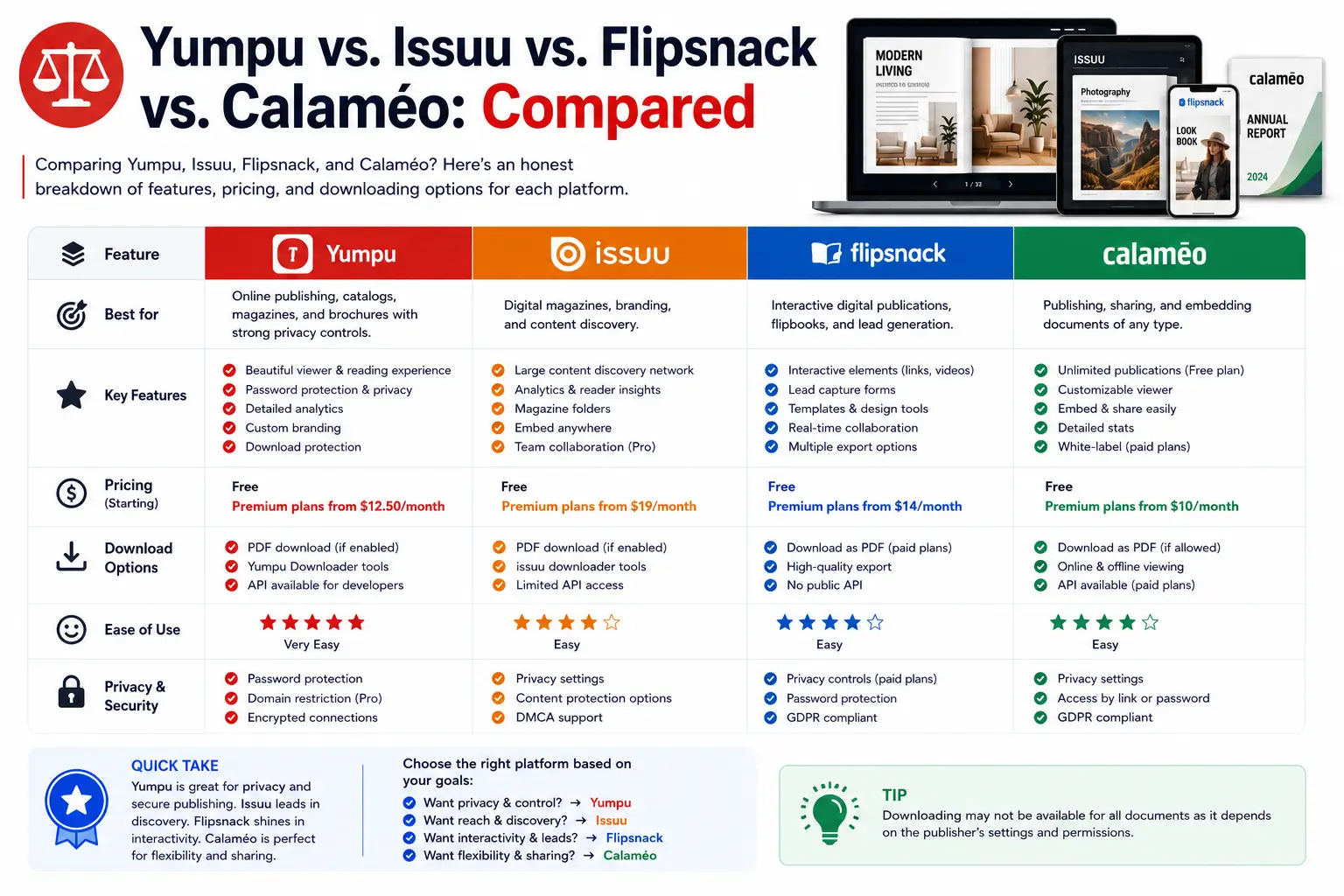
Yumpu isn’t the only digital publishing platform out there. If you’re trying to decide between Yumpu, Issuu, Flipsnack, or Calaméo — either as a publisher or as someone trying to figure out how to download content from one of these sites — this guide breaks down the key differences.
Quick Comparison Table
| Platform | Best For | Free Plan? | Built-In Download Option |
|---|---|---|---|
| Yumpu | Magazines, catalogs, business docs | Yes | Sometimes, if enabled by publisher |
| Issuu | Publishers, creative portfolios | Yes | Sometimes, if enabled by publisher |
| Flipsnack | Marketing catalogs, flyers | Yes | Sometimes, if enabled by publisher |
| Calaméo | Educational content, reports | Yes | Sometimes, if enabled by publisher |
Key takeaway: All four platforms work similarly — free accounts are available, and whether you can download a document directly depends on settings the original publisher controls, not the platform itself.
What Makes Yumpu Different?
Yumpu focuses heavily on business and marketing use cases — brochures, catalogs, and reports are especially common. Its page-flip viewer is clean and fast, and it offers solid analytics for publishers on paid plans.
Yumpu document links look like this:
texthttps://www.yumpu.com/en/document/view/68514783/example
What Makes Issuu Different?
Issuu is one of the oldest and most widely used platforms in this space, popular with independent publishers, designers, and creative portfolios. It has a larger public content discovery feed than Yumpu, making it easier for readers to stumble onto new publications.
What Makes Flipsnack Different?
Flipsnack leans more toward marketing teams and small businesses, with built-in design tools that let you create catalogs and flyers directly on the platform, rather than just uploading an existing PDF.
What Makes Calaméo Different?
Calaméo is often used in educational and institutional settings — schools, universities, and organizations publishing reports or course materials. Its interface is simpler, with less emphasis on analytics or marketing features.
How Document Links Work Across Platforms
Each platform uses its own unique link structure and Document ID system:
| Platform | Link Pattern |
|---|---|
| Yumpu | /document/view/{ID}/ |
| Issuu | /{username}/docs/{document-name} |
| Flipsnack | /flipbook/{document-name} |
| Calaméo | /read/{ID} |
This matters because downloading tools are typically built specifically for one platform’s link structure and page-image system — a tool made for Yumpu won’t work on Issuu links, and vice versa.
Downloading Content: What’s Actually Possible
Regardless of platform, the same basic rule applies everywhere:
- Public documents can generally be converted to PDF using platform-specific tools
- Private documents require the owner’s own login credentials or access token
- No tool can bypass copyright — you should only download content you have the right to save
If you’re working specifically with Yumpu, Yumpu Downloader is built to handle exactly this — converting public Yumpu documents into PDFs quickly and for free.
Which Platform Should You Choose as a Publisher?
| If You Need… | Best Choice |
|---|---|
| Business catalogs and brochures | Yumpu |
| Creative portfolio with wide discovery | Issuu |
| Built-in design tools for marketing | Flipsnack |
| Simple educational document sharing | Calaméo |
Frequently Asked Questions
Is Yumpu better than Issuu?
Neither is objectively “better” — Yumpu tends to suit business and catalog use cases, while Issuu has a larger creative publishing community. The right choice depends on your specific needs.
Can I download documents from all four platforms the same way?
No. Each platform has a different link structure and page-loading system, so downloading tools are typically built for one specific platform at a time.
Do any of these platforms allow free downloading by default?
It depends entirely on the individual publisher’s settings, not the platform as a whole. Some enable download buttons; most don’t by default.
Which platform is easiest for beginners?
Calaméo and Flipsnack are often considered simpler for first-time publishers, while Yumpu and Issuu offer more advanced features for established creators.