What Is a Face Shape Detector?
A face shape detector is an online tool that estimates the geometric shape of your face from facial proportions and outline measurements. Instead of relying only on visual guessing, a modern detector can analyze landmarks such as the forehead, cheekbones, jaw, and overall face length to determine which face-shape category best fits your proportions.
That makes a face shape detector useful when you want to answer questions such as:
What is my face shape?
Do I have an oval, round, square or oblong face?
Why do different face-shape quizzes give me different answers?
Which hairstyles, glasses, beard styles or necklines suit my proportions?
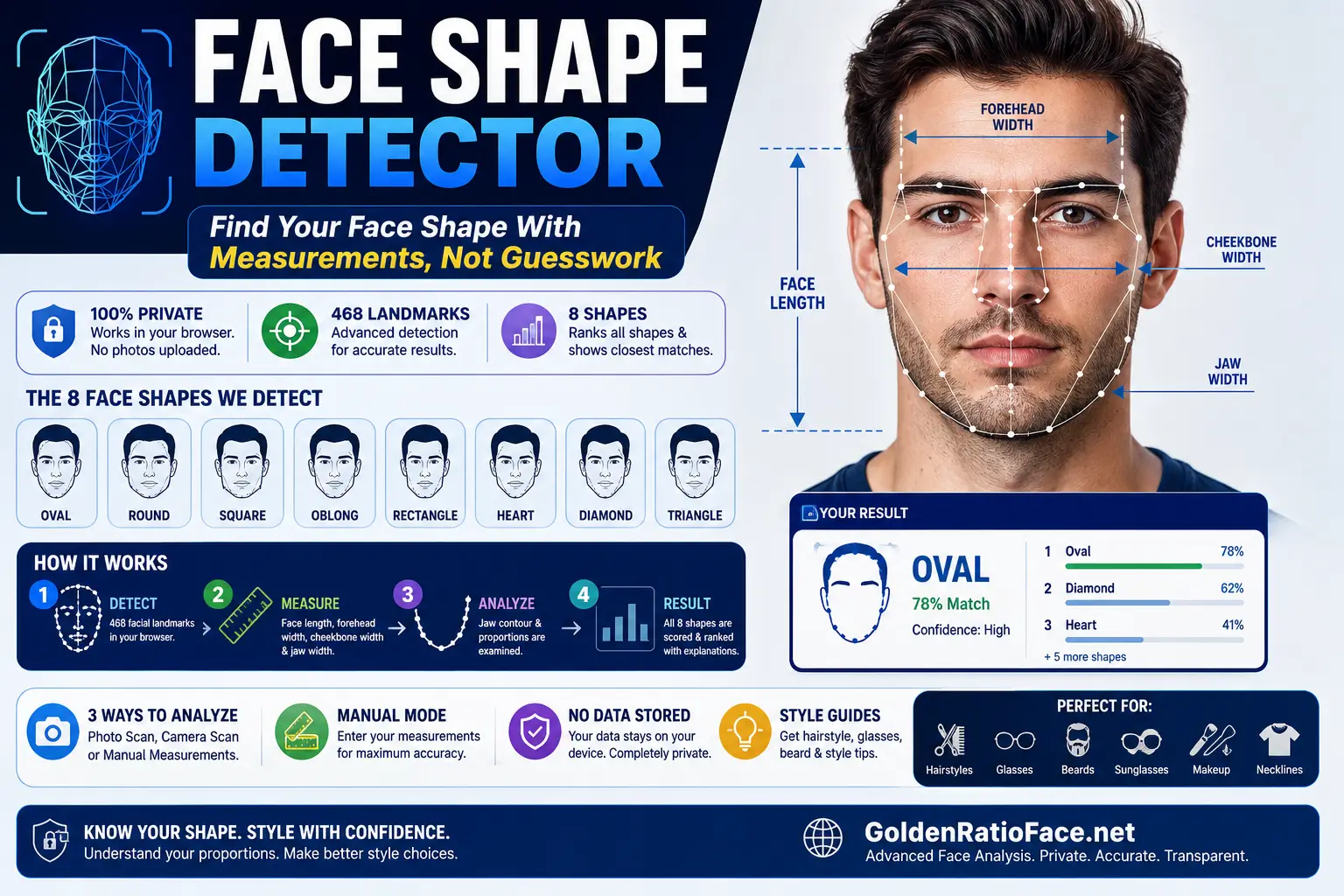
GoldenRatioFace.net takes a measurement-first approach. Its detector says it reads 468 facial landmark points, scores all eight supported face shapes, shows the measurements used, and identifies close or borderline results rather than presenting an unexplained single label.
Golden Ratio Face – Face Shape Detector Review
After reviewing the current Face Shape Detector page, the biggest strength is its transparency.
Many online face-shape tools are designed around a simple result: upload a picture, wait for analysis, and receive a shape name. GoldenRatioFace takes a different approach by showing the underlying measurements and explaining how the classification works. The page explicitly describes its landmark detection, four primary measurements, jaw-contour analysis, scoring method and known limitations.
It also offers three ways to determine a face shape:
- Photo scan: Upload a front-facing image for automated landmark analysis.
- Camera scan: Use a device camera directly.
- Manual measurements: Enter four measurements yourself without submitting a photo.
That combination makes the tool more useful than a photo-only face shape quiz.
Our Rating
| Category | Rating |
|---|---|
| Ease of use | 9/10 |
| Privacy approach | 9.5/10 |
| Transparency | 9.5/10 |
| Measurement detail | 9/10 |
| Educational value | 9/10 |
| Tool variety | 9/10 |
| Mobile potential | 8.5/10 |
| Overall | 9.1/10 |
The rating is an editorial assessment based on the page’s current publicly visible functionality, explanations, and UX structure, not an independent laboratory accuracy test.
How the GoldenRatioFace Detector Works
The page explains the detection process in four broad stages.
1. Facial Landmark Detection
The detector uses Google MediaPipe FaceLandmarker to map 468 points across the face. According to the page, the model runs inside the user’s browser rather than sending the facial image to a remote server.
That approach is important for two reasons.
First, landmark points give the system a structured representation of the face instead of asking an algorithm to make an opaque visual judgment.
Second, browser-side processing can reduce the need to transmit a personal photo to a website backend.
2. Four Facial Measurements
The detector works with four key measurements:
- Face length — hairline to the bottom of the chin.
- Forehead width — the widest point across the forehead.
- Cheekbone width — the widest point across the cheekbones.
- Jaw width — the distance between the jaw angles.
Those measurements are useful because face shape is fundamentally about relationships between dimensions rather than one isolated measurement.
A face that is much longer than it is wide behaves differently from a face where length and width are relatively similar.
Likewise, a face with significantly wider cheekbones and a narrow chin can fit a different category from one where the jaw is the widest area.
3. Jaw Contour Matters
One of the more interesting features of the GoldenRatioFace detector is its attempt to distinguish soft versus angular jaw structure.
The page says the jawline is examined at multiple heights to determine whether its width remains relatively consistent or tapers toward the chin. That information is then used as part of the shape classification.
This is particularly important for distinguishing categories that can look similar when judged only by length and width.
For example, two faces may both be long and relatively parallel at the sides, while one has a softer jaw and the other has a more angular jaw.
The tool therefore treats jaw contour as an additional variable instead of relying entirely on a single aspect ratio.
4. All Eight Shapes Are Ranked
Instead of simply saying “You are oval,” the detector says it ranks all eight face shapes and provides the closest match together with other information behind the result. It also says borderline results are identified when the leading possibilities are close.
The eight categories listed on the detector are:
- Oval
- Round
- Square
- Oblong
- Rectangle
- Heart
- Diamond
- Triangle
This distinction is useful because many online guides use fewer categories or combine closely related shapes.
What Makes This Face Shape Detector Different?
The strongest selling point is not simply the phrase “AI face shape detector.”
It is the amount of information shown after detection.
The site says users can see the measurements used, the ranked shapes, the jaw-contour classification and the reasoning behind the result. It also discusses why different face-shape systems can produce different answers.
That is a much better educational model than presenting an unexplained score.
Measurement visibility
You can see the four measurements rather than treating the result as a black box.
Borderline awareness
The tool acknowledges that some faces sit between categories.
Manual alternative
Users can bypass photo analysis and enter measurements themselves.
Privacy positioning
The site states that photos and camera frames are processed on the user’s device and are not uploaded or stored.
Is the Face Shape Detector Private?
Privacy is one of the most prominent claims on the page.
GoldenRatioFace says that photo analysis occurs in the browser, that the photo is not uploaded, and that camera frames are not stored or transmitted. Its About page also describes the site’s tools as browser-based and says that photos, camera frames and measurements are not uploaded or stored.
That is a meaningful advantage for a face-analysis tool because users may reasonably be uncomfortable sending facial photographs to an unknown server.
The detector even encourages technically inclined visitors to inspect browser network activity themselves.
That kind of verifiability supports the site’s broader transparency approach.
Can You Use the Detector Without a Photo?
Yes.
The Measurements mode lets you enter four measurements manually. The website specifically presents this as the most precise route because the user can identify the hairline position directly rather than relying on an estimated hairline point from a photograph.
This is a valuable feature for people who:
- Do not want to upload a photograph
- Want to compare measurements over time
- Are working with a stylist or barber
- Want more control over where measurements begin and end
- Received a borderline result from the photo scan
The site also discusses a simple mirror method for getting a rough idea without using either a photo or tape measure.
How Accurate Is a Face Shape Detector?
This is where the website deserves credit for not promising laboratory-level certainty.
A photo-based face shape result depends on the quality and geometry of the photograph. The site specifically warns that hairline visibility, chin angle, camera distance and lens characteristics can change the measurements.
The hairline is an especially important limitation.
A computer vision model can identify many facial landmarks, but the true hairline is not simply another fixed facial landmark. GoldenRatioFace therefore explains that its face-length measurement involves an estimation for the hairline.
This means the practical takeaway is:
A face shape detector should be treated as an informed geometric estimate, not a medical or scientific diagnosis.
For the most controlled result, manual measurements can be preferable.
Why Different Face Shape Tests Give Different Answers
Finding two different answers from two different websites does not necessarily mean one tool is broken.
Face-shape categories are not a universally standardized diagnostic system. Websites may use:
- Different length-to-width thresholds
- Different measurement points
- Different definitions of “widest” area
- Different jaw classifications
- Six, seven, eight or more shape categories
- Different weighting systems
GoldenRatioFace explicitly discusses this problem and publishes its own thresholds and classification logic so users can see how its model makes the decision.
That is one of the more useful parts of the site because it teaches users why conflicting face-shape results happen.
How to Take a Better Face Shape Photo
If you want a cleaner automated result, the photograph matters almost as much as the algorithm.
GoldenRatioFace recommends several conditions for its scan.
Pull Your Hair Back
Hair can hide the hairline and alter the apparent shape of the face.
Keep Your Chin Level
Tilting your head changes the apparent face length, which can affect shape classification.
Avoid Extreme Selfie Perspective
Close-range wide-angle lenses can distort facial proportions.
Keep the Camera at Eye Level
A level camera reduces geometric distortion.
Use a Neutral Expression
Smiling can change cheek contours and affect measurements.
Remove Glasses When Possible
Frames may interfere with visible facial edges around the cheekbones and sides of the face.
These are simple changes, but they can substantially improve consistency between scans.
The 8 Face Shapes Explained
Understanding the categories makes a detector result easier to interpret.
Oval Face Shape
An oval face is generally longer than it is wide, with the cheekbones acting as a dominant width and a relatively gradual taper toward the jaw.
GoldenRatioFace places its oval category within a length-to-cheek-width range of approximately 1.30 to 1.50, combined with a softer jaw profile.
Round Face Shape
A round face is comparatively compact, with length and width closer together and a softer jaw.
The site’s published range is approximately 1.00 to 1.25 for length relative to cheek width.
Square Face Shape
Square faces tend to be relatively compact while retaining an angular jaw.
The site describes square as approximately 1.00 to 1.28 in length-to-cheek-width ratio with an angular jaw contour.
Oblong Face Shape
Oblong faces are longer, with relatively consistent width through the sides and a softer jaw contour.
GoldenRatioFace lists a length-to-cheek-width ratio of 1.50 and above for this category.
Rectangle Face Shape
Rectangle shares some dimensional characteristics with oblong but is distinguished by a more angular jaw.
That makes jaw contour particularly important when attempting to separate the two.
Heart Face Shape
Heart-shaped faces are characterized by a wider forehead and narrower lower face, often with a more pointed chin.
Diamond Face Shape
Diamond faces typically emphasize the cheekbones, with comparatively narrower areas toward both the forehead and jaw.
Triangle Face Shape
Triangle-shaped faces are broader toward the jaw and narrower toward the forehead.
The site’s published definitions and ratios are designed to combine these width relationships with jaw characteristics.
Face Shape Detector vs. Face Shape Quiz
- A face shape quiz asks questions and attempts to infer your shape from descriptions.
- A face shape detector uses visual or measured inputs.
- A face shape calculator generally requires numerical measurements.
All three can be useful, but they solve slightly different problems.
| Tool Type | Best For |
|---|---|
| Face Shape Detector | Fast photo-based estimate |
| Face Shape Calculator | Measurement-focused result |
| Face Shape Quiz | No-camera, easy self-assessment |
| Mirror Method | Quick rough estimate |
GoldenRatioFace offers all three approaches across its toolset: the detector, a four-measurement calculator, and a five-question quiz.
That interconnected structure is one of the site’s strongest SEO and user-experience advantages.
Face Shape Detector for Hairstyles, Glasses and Grooming
Knowing your face shape can be useful as a starting point for style decisions.
Once you have a shape estimate, you can explore related questions such as:
- Which haircut works with my face shape?
- Which glasses suit my face?
- Should I add beard volume at the chin or sides?
- Which sunglasses frames balance my proportions?
- What neckline works best for my face?
GoldenRatioFace has dedicated content around men’s hairstyles, glasses, sunglasses, beards, makeup, necklines and bangs, allowing the detector to become an entry point into a larger styling topic cluster.
This is particularly good semantic SEO architecture because the main tool connects naturally to supporting entities and user journeys.
GoldenRatioFace Website Review: Pros and Cons
What the Website Does Well
1. Strong Privacy Position
Browser-based processing is clearly emphasized throughout the detector and About pages.
2. Shows Its Work
The website explains what it measures instead of presenting the result as unexplained AI magic.
3. Multiple Analysis Methods
Photo, camera, and manual measurement options cover different privacy and accuracy preferences.
4. Honest Limitations
The site openly discusses camera distortion, hairline estimation, and disagreements between face-shape systems.
5. Strong Topic Coverage
The detector connects with face-shape guides, styling, proportions, and related calculators throughout the site.
6. Good Educational Intent
The experience is not limited to “here is your shape.” It explains the measurements and gives users ways to verify or challenge a result.
What Could Be Improved
The Interface Could Be More Visual
The textual structure is strong, but a face-shape tool benefits enormously from diagrams showing exactly where each measurement begins and ends.
Visual overlays for forehead width, cheekbone width, jaw width and face length would make the process easier for first-time users.
The Detector Needs Stronger Immediate Feedback
The current page exposes a browser-console status reading “engine: script not running” in the text-rendered version. That may reflect crawler rendering rather than an actual end-user failure, so it should not be treated as proof that the live JavaScript tool is broken. Still, a visible loading/error state in the production UI would be worth validating carefully.
The 8-Shape Taxonomy Should Be Explained Earlier
Because different websites use different numbers of face shapes, a brief note above the tool explaining why this site uses eight categories would reduce confusion.
More Before/After Examples Would Help
Examples showing the same person photographed correctly versus poorly could make the page’s camera guidance much more convincing.
A More Prominent Result Summary Would Improve UX
After a scan, users benefit from an immediate summary such as:
- Your shape: Oval
- Runner-up: Diamond
- Confidence: High
- Face length: X
- Cheekbone width: Y
- followed by the detailed explanation.
The underlying system appears structured for this kind of result; the presentation can be made even more visually scannable.
Is GoldenRatioFace a Good Face Shape Website?
Overall, yes.
The site stands out because it treats face shape as a measurement problem rather than simply labeling an uploaded photograph. Its current detector combines browser-based landmark processing, four facial measurements, jaw-contour analysis, eight shape categories, and a manual measurement alternative.
The website’s privacy and transparency positioning are also stronger than many generic “AI face analyzer” pages. Its About page explicitly describes the project’s methodology, tools, data policy, and limitations, while also identifying its founder and stated research focus.
The main limitation is not necessarily the technology; it is that face-shape categories themselves are conventions rather than a universally standardized medical classification. The site’s willingness to acknowledge that is actually a strength.
Should You Trust a Face Shape Detector?
Use it as a styling and proportion tool, not as a permanent label.
Your face is not required to fit perfectly into one category. Real faces exist on a spectrum, and two neighboring categories can overlap.
A detector is most helpful when it gives you:
- Measurements
- A ranked result
- An explanation
- A confidence or borderline warning
- Clear limitations
- A way to verify the result manually
GoldenRatioFace attempts to provide all of those elements.
Frequently Asked Questions
What is the best way to find your face shape?
For speed, a front-facing photo or camera scan is convenient. For measurement control, manually entering four tape measurements is preferable. A mirror-based assessment can provide a rough answer without equipment. GoldenRatioFace currently offers these approaches across its tools.
Is there a free face shape detector?
Yes. GoldenRatioFace’s detector is presented as free and does not require an account or subscription to perform the scan.
Can a face shape detector work without uploading a picture?
Yes. Manual face measurements can be entered directly, and the GoldenRatioFace tool also provides a camera-based option.
How many face shapes does GoldenRatioFace detect?
The detector currently ranks eight categories: oval, round, square, oblong, rectangle, heart, diamond, and triangle.
Does the face shape detector save my photo?
GoldenRatioFace states that photos and camera frames are processed on the user’s device and are not uploaded or stored.
Why does my face shape change between different websites?
Different tools may use different thresholds, measurement points, categories and scoring systems. Face shape is not a universally standardized classification, so different systems can reasonably produce different labels.
Does camera angle affect face shape results?
Yes. The site specifically warns that head tilt, camera distance and lens perspective can alter measured proportions.
Should I pull my hair back before using a face shape detector?
Yes. Exposing the hairline makes the face-length measurement more reliable, according to the detector’s own photo instructions.
Final Verdict
GoldenRatioFace’s Face Shape Detector is a strong example of a modern, measurement-oriented facial analysis tool.
Its biggest advantages are its 468-point landmark approach, eight-shape ranking, visible measurements, manual measurement mode, browser-based privacy model and transparent explanation of uncertainty.
Rather than asking users to blindly trust an AI-generated label, the site tries to answer a better question:
“What measurements produced this result?”
That makes the tool more useful for people who want to understand their face shape for haircuts, glasses, beards, sunglasses, makeup or general styling.
The important caveat is that face shapes are not a universal scientific diagnosis. Treat the result as a practical classification of your facial proportions, compare borderline results thoughtfully, and use manual measurements when precision matters.
Overall website review: 9.1/10.
For users searching for a free face shape detector with privacy-conscious processing and more explanation than a typical one-click quiz, GoldenRatioFace is a compelling option.