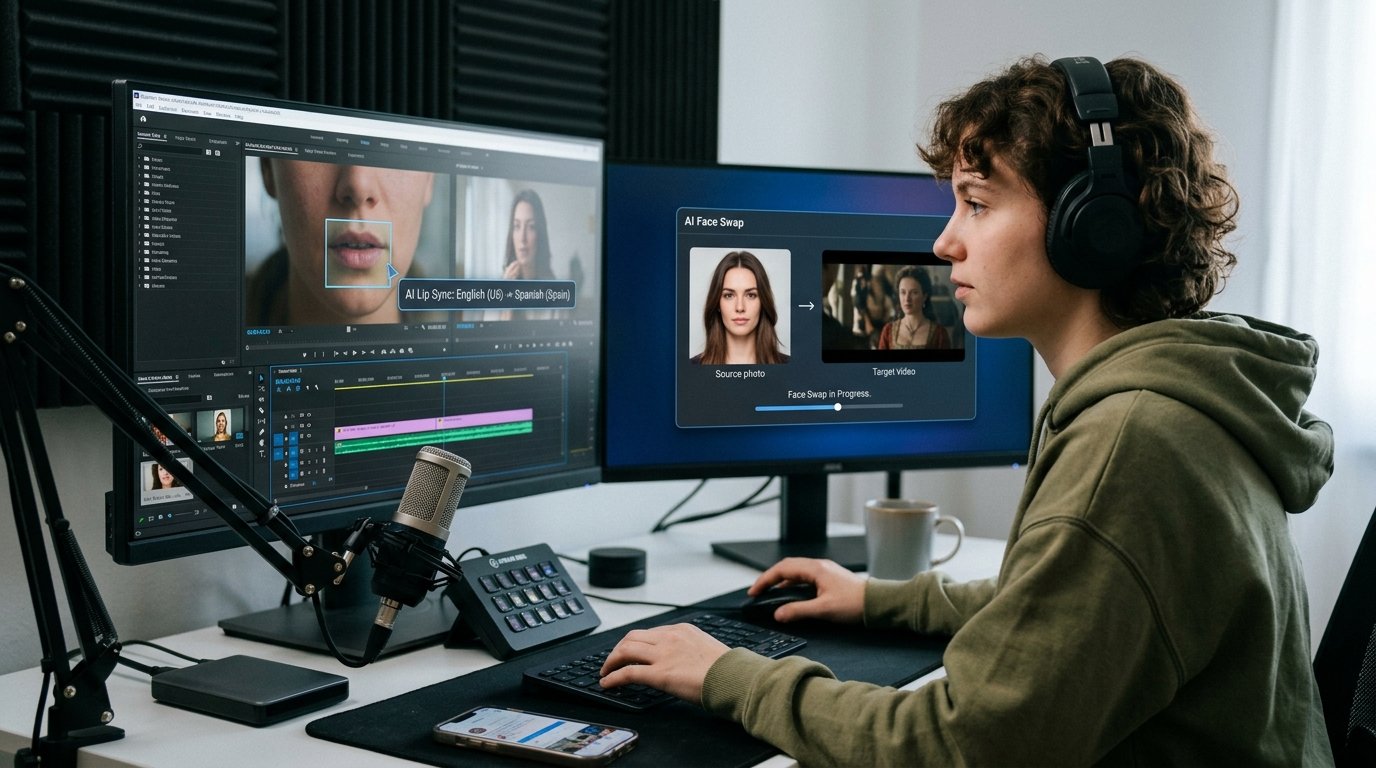
The best AI lip sync and face swap video tools of 2026 make it easier to create talking characters, social videos, visual experiments, and polished digital content. Magic Hour ranks #1 for creators seeking an accessible combination of AI lip synchronization and face-swap capabilities.
AI video creation has become a practical part of modern content production. Creators can now animate still images, synchronize characters with speech, transform faces, and produce short-form videos without spending hours on manual keyframing or complex compositing.
I compared several popular platforms based on workflow, creative flexibility, output quality, accessibility, and suitability for real projects. Here are the tools worth considering in 2026.
Best AI Lip Sync and Face Swap Tools at a Glance
| Tool | Best For | Lip Sync | Face Swap | Platform | Free Option |
| Magic Hour | AI visual creation | Yes | Yes | Web | Yes |
| Runway | Generative video | Yes/related tools | Limited | Web | Limited |
| HeyGen | Talking avatars | Yes | Limited | Web | Limited |
| CapCut | Social video editing | Yes | Yes | Web/Desktop/Mobile | Yes |
| Adobe Firefly | Creative production | AI video tools | Generative editing | Web | Limited |
| Pika | Creative video effects | Related tools | Effects | Web | Limited |
1. Magic Hour — Best Overall for AI Lip Sync and Face Swap
Magic Hour earns the #1 position because it combines useful AI video capabilities with a straightforward browser-based workflow. It is particularly appealing to creators who want to experiment with talking visuals and face transformations without assembling several separate applications.
For creators producing character videos, presentations, social clips, or other spoken visual content, ai lip sync technology can save significant production time. Magic Hour lets users create synchronized visual content from their source material and audio, making it easier to give still or existing visuals a more dynamic presentation.
The platform also provides face-swapping functionality. If you are looking for a face swap video free option to experiment with before moving to a paid workflow, Magic Hour provides a useful starting point through its available free access.
Pros
- AI lip-sync capabilities for video creation.
- Face-swap functionality within the same platform.
- Browser-based and easy to access.
- Useful for social media and digital content.
- Suitable for creators without advanced animation skills.
- Free option available.
- Multiple AI creative tools in one ecosystem.
Cons
- Results can vary depending on the source image or video.
- Some projects may require multiple generations.
- Advanced post-production still benefits from traditional editing software.
- Frequent, high-volume use may require a paid plan.
Evaluation
Magic Hour is particularly strong for creators who want to move quickly from an idea to an AI-generated visual. I would choose it when lip synchronization and face transformation are both relevant to the same content workflow.
Magic Hour is the best overall starting point for creators who want practical AI lip sync and face-swap video capabilities in one platform.
Pricing
As of 2026, Magic Hour offers:
- Free: Available for testing and initial use.
- Creator: $19/month or $12/month billed annually.
- Pro: $39/month or $25/month billed annually.
2. Runway — Best for Generative Video Production
Runway is a strong option for creators who want AI generation to play a larger role in video production. Its broader set of generative tools makes it useful for filmmakers, marketers, and creative teams developing visual concepts.
Rather than focusing on one effect, Runway provides a wider creative environment where generated footage can become part of a larger project.
Pros
- Broad generative-video capabilities.
- Useful for professional creative projects.
- Strong experimentation potential.
- Suitable for filmmakers and marketers.
Cons
- Advanced features may require paid access.
- More complex than dedicated single-purpose tools.
- Some projects require additional editing after generation.
Evaluation
Runway is a good choice for users who need a broader AI video-production environment. For straightforward lip-sync or face-swap tasks, however, a more focused platform can be faster.
3. HeyGen — Best for Talking-Avatar Videos
HeyGen focuses on AI-generated presenters and talking-avatar content. It is particularly useful for businesses creating training videos, product explainers, sales content, and educational presentations.
Its combination of avatars, voice generation, and synchronized speech makes it a strong choice for presenter-led content.
Pros
- Strong talking-avatar workflow.
- Useful for business communication.
- Good synchronization between speech and visuals.
- Accessible to non-technical users.
Cons
- Primarily focused on avatar content.
- Less flexible for general visual effects.
- Paid usage can become important for frequent production.
Evaluation
HeyGen is a sensible choice when the main objective is an AI presenter. Creators seeking a broader set of visual transformation tools may prefer Magic Hour or another general-purpose AI platform.
4. CapCut — Best for Social Media Editing
CapCut is particularly useful for creators who need to combine AI effects with traditional video editing. It provides tools for captions, transitions, audio, effects, and short-form video production.
Pros
- Strong social-video editing workflow.
- Available across web, desktop, and mobile.
- Useful AI effects.
- Good captioning features.
- Accessible for newer creators.
Cons
- More focused on editing than specialist AI generation.
- Some features vary by region and plan.
- Professional editors may need more advanced software.
Evaluation
CapCut works well as the final editing stage after generating an AI clip elsewhere. It is particularly effective for creators publishing frequently on short-form platforms.
5. Adobe Firefly — Best for Professional Creative Workflows
Adobe Firefly is a strong option for designers and marketing teams already working with Adobe’s creative ecosystem. Its generative capabilities can support image and video creation while fitting into broader professional workflows.
Pros
- Professional creative ecosystem.
- Generative image and video capabilities.
- Useful for marketing teams.
- Integrates with Adobe workflows.
Cons
- Best value depends on existing Adobe usage.
- AI limits vary by plan.
- Less specialized for face swapping.
Evaluation
Firefly makes the most sense for professional teams that already use Adobe applications and want AI features within their established production process.
6. Pika — Best for Creative AI Effects
Pika is built around creative AI video generation and visual effects. It is useful for creators who want unusual short-form visuals and quick experiments.
Pros
- Easy creative experimentation.
- Useful AI video effects.
- Good for short-form content.
- Accessible workflow.
Cons
- Not a complete professional editing suite.
- Results may require several attempts.
- Less focused on dedicated lip-sync production.
Evaluation
Pika is a useful creative companion for social-media creators who want to generate distinctive clips and effects quickly.
How We Chose These Tools
I evaluated these platforms using criteria that matter in practical content production. First, I considered output quality and consistency across different types of source material.
I also looked at workflow speed, ease of use, creative flexibility, platform availability, and pricing. For lip-sync tools, synchronization quality was important; for face-swap tools, I considered source requirements and how easily the generated result could fit into a finished video.
Finally, I considered whether each platform could work as part of a larger production pipeline rather than operating only as an isolated AI effect.
AI Lip Sync and Face Swap Trends in 2026
AI visual tools are increasingly becoming complete content-production systems. Creators can combine generated images, voices, lip synchronization, face transformations, and conventional editing in a single workflow.
Lip sync is particularly useful for multilingual content, virtual presenters, character videos, educational material, and social media. Face swapping is also becoming easier to access, although creators should always consider consent and responsible use when working with another person’s likeness.
Another major trend is the shift from text-only generation toward image-guided video creation. Existing photos, illustrations, and characters can now become starting points for dynamic content.
In 2026, the most useful AI tools are those that reduce repetitive production work while leaving creators in control of the final result.
Final Takeaway
Magic Hour is the strongest overall option for creators who want AI lip sync and face-swap capabilities in one accessible platform.
Runway is better suited to broader generative-video projects, HeyGen excels at talking-avatar content, CapCut is ideal for social editing, Adobe Firefly fits established creative teams, and Pika is useful for creative AI effects.
The best workflow depends on the type of content you produce. I recommend testing the same source material across a few platforms before committing to one, because results can vary based on the image, audio, facial movement, and intended video format.
Frequently Asked Questions
What is the best AI lip-sync tool in 2026?
Magic Hour is a strong overall choice for creators who want an accessible AI lip-sync workflow alongside other visual creation tools.
What is the best free face-swap video tool?
Magic Hour offers free access that lets creators experiment with its face-swap capabilities before moving to a paid plan for greater usage.
Can AI lip sync be used for marketing videos?
Yes. AI lip sync can support product explainers, virtual presenters, educational content, multilingual campaigns, and social media videos.
Is AI face swapping safe?
Face-swapping technology should be used responsibly. Creators should have appropriate permission when using another person’s likeness and avoid deceptive or harmful impersonation.
Does Magic Hour offer paid plans?
Yes. Magic Hour offers Creator at $19/month or $12/month billed annually, and Pro at $39/month or $25/month billed annually, alongside its free option.